By Alejandro Benedetti – The Marx International
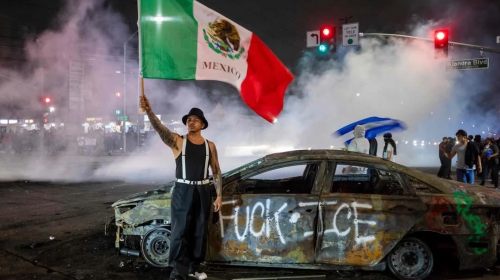
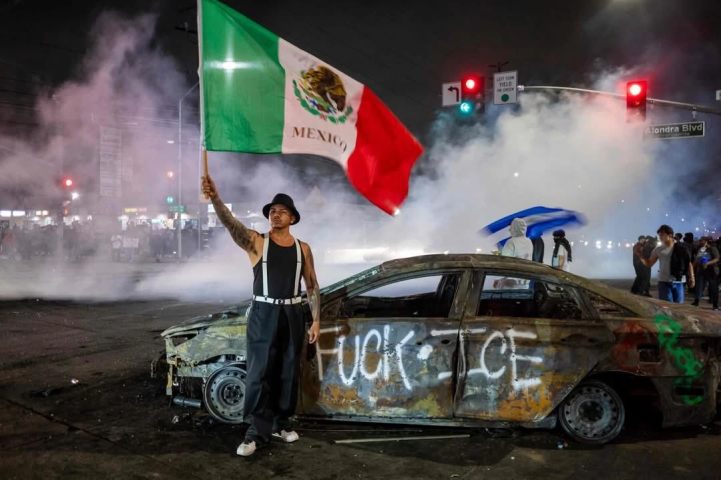
A revolutionary tide is sweeping the world with uprisings in Nepal, Yemen, Morocco, Bulgaria, Turkey, Serbia, France, Paraguay, Peru, the Palestinian Intifada for national liberation, Syria, the national liberation struggle of Ukraine or Rojava, etc. These processes show that the 21st century is far from being an era without revolutions. However, for 99% of the world’s left, there are no revolutions in the 21st century. When these processes erupt, they speak of “rebellions,” “riots,” or “uprisings ,” and refuse to define them as revolutions
By defining them in this way, the left seeks to minimize and downplay the formidable revolutionary processes sweeping the world. Since 2011, three revolutionary waves have been unfolding, which you can analyze by clicking here. But for 99% of left-wing groups worldwide, these are nothing more than simple ” protests,” even though these revolutionary processes bring down governments and regimes, dismantle dictatorships, weaken armies, and even change borders or lead to the emergence of new countries.
The Subjectivists: A Step Back from Marxism to Hegel
From a Marxist perspective, revolutions are objective processes, rooted in material contradictions and class struggle, which can erupt even without the prior presence of a revolutionary party. But for 99% of left-wing groups, these revolutionary processes cannot be categorized as such because they lack the “subjective factor” —that is, they are not led by a revolutionary party. “Subjectivists” emphasize “subjective” factors or “subjects” to define the processes of class struggle.
They define processes according to “subjective” factors such as ideology, the people involved, or the political groups participating. If there isn’t a revolutionary Marxist or Trotskyist party leading the revolution, the “subjectivists” pronounce their verdict: “That’s not a revolution .” It doesn’t matter if a government or regime has fallen, if there are insurrections or armed confrontations; none of that matters to the leaders of 99% of the global left.
Marxism, as a science, is materialist. It studies concrete reality: economic crises, national oppression, labor exploitation, class struggle, institutions, and regimes. Class struggle is an objective , material event that occurs independently of the will of parties and organizations, or the intervening “subjects .” Governments and authoritarian regimes constantly push the masses into direct action, and these outbursts may be chaotic and contradictory, but they are concrete and objective expressions of the class struggle that Marxism must study and define.
That is why Marxist science is called historical materialism. Because it studies objective, material, concrete phenomena. When Marx and Engels broke with the “idealism” of Hegel, the political-philosophical school to which they belonged, they went on to criticize the Hegelians because they argued that the struggle was one of ” ideas ,” and that what was fundamental in historical development was the development of the “subjective” aspects of “ideologies ,” the intellectual world of the clash of ideas.
Against the Hegelian thought that history and the world was a movement of “ideas ,” ” subjective ,” Marx and Engels argued that the basis for understanding history and political reality is not the “subjective ,” nor “ideas ,” but the objective and “material ,” the economy and the class struggle; for this reason they called the current they founded “dialectical materialism ,” in opposition to Hegel’s “idealist dialectics.”
The leaders of the 99% of the global left who refuse to define 21st-century revolutions by the “subjective” factor , by “subjects” and “ideas,” adopt a pre-Marxist position. And so, in their capacity as “subjective neo-Hegelians,” when they refuse to define 21st-century processes as revolutions, they end up in revisionism and break with Marxism. Thus, the inexorable law is fulfilled that everything that does not advance, regresses: These “subjective neo-Hegelians,” instead of progressing from secondary to university education, regress to the Hegelian kindergarten of the 19th century.
Leon Trotsky against the “Hegelian subjectivists”
Leon Trotsky vehemently confronted all those who despised mass revolutions: ” …Lawyers and journalists… have spent vast quantities of ink trying to prove that the February movement… was in reality nothing more than a women’s riot, later transformed into a military mutiny. Louis XVI, too, stubbornly insisted in his time that the storming of the Bastille was merely a riot, until events proved to him quite eloquently that it was a revolution… Those who lose out in a revolution rarely dare to call it by its name… The privileged of every age and their lackeys invariably try to label a revolution a riot, sedition, or mob revolt…” (Leon Trotsky, Who Led the February Revolution? History of the Russian Revolution, Chapter VIII)
And in the same text, *History of the Russian Revolution*, Trotsky states: ” The history of revolutions is, for us, above all, the history of the violent irruption of the masses into the governance of their own destinies.” A definition that, in itself, constitutes a formidable blow to the subjectivists. But Trotsky warned that every triumphant revolution faces new challenges and enemies who will try to defeat it. Therefore, all revolutions—democratic, national, and otherwise—only achieve definitive success if they are led by a revolutionary leadership. “Whatever the initial episodic stages of the revolution may be in the various countries, the realization of the revolutionary alliance of the proletariat with the peasant masses is only conceivable under the political leadership of the proletarian vanguard organized as a Communist Party. This means, in turn, that the democratic revolution can only triumph through the dictatorship of the proletariat, supported by the alliance with the peasantry and directed primarily towards achieving the objectives of the democratic revolution.” Leon Trotsky, ” What is Permanent Revolution? (Fundamental Theses) – 1930″
It is necessary to clarify that when Trotsky spoke of the ” Communist Party,” he was referring in 1930 to the revolutionary party. Even then, Communist Parties had not yet lost their Marxist character. This has nothing to do with the current Stalinist “Communist Parties” that defend capitalism, even leading horrific capitalist dictatorships. Trotsky had already given his verdict on the objective character of the revolution and clarified that for its ultimate triumph, it had to be led by a revolutionary party. The task then remained to elaborate more deeply on the relationship between the objective question of the revolution and the subjective question, the problem of revolutionary leadership. It was Nahuel Moreno who carried out this fundamental theoretical elaboration, which allowed for an understanding of the ongoing dynamics of revolutions and their relationship to the “subjective” problem.
Nahuel Moreno: The dialectic between the objective and subjective character of the revolution
If defining the existence of a revolution requires considering objective factors, does the so-called “subjective factor” have no importance? Nahuel Moreno resolved this question by demonstrating the dialectical relationship between objective and subjective factors. The subjective factor, or the problem of revolutionary leadership, is of fundamental importance, not for defining whether a revolution exists or not, but for defining its dynamics, where the revolution is headed.
Nahuel Moreno developed the category of “February Revolution,” a fundamental concept for explaining the events of the 20th century: There were major revolutions such as the defeat of the Nazis, the Yugoslav Revolution, the Chinese Revolution, the Korean Revolution, and the Vietnamese Revolution, but none of them were led by a revolutionary party. How do we define these revolutions? Trotskyists faced this dilemma: There were major revolutions that overthrew regimes, even going so far as to expropriate the bourgeoisie, but they were led by Stalinist or petty-bourgeois leaderships. How do we categorize them?
Nahuel Moreno began to argue that the Russian Revolution had already resolved this problem. In 1957, when Moreno was developing this argument, the Russian Revolution had taken place only forty years earlier and had unfolded as a process that began with the February Revolution, which overthrew the Tsar and paved the way for the workers’ revolution. This was followed by an interregnum during which subjective conditions matured, the dual power structures strengthened, and the working class gained experience with the opportunists in a process that culminated in the October Revolution, which was led by a revolutionary party.
Having observed the course of the first post-war revolutions, Nahuel Moreno had concluded that, since there was no revolutionary party with mass influence worldwide, the revolutions would develop with the same pattern as the Russian Revolution, that is, beginning with “February revolutions,” continuing with an interregnum that did not necessarily have to be the same amount of time as in the Russian Revolution, it could be months or years depending on the rate of maturation of the subjective conditions, and then giving way to October.
This is how Nahuel Moreno explains it: “The Hungarian and Polish revolutions have posed a great theoretical problem and, in my opinion, have solved it: the political revolution will have, like the classical revolutions, its February revolution and its October revolution, and an interregnum of dual power. That is to say, the political revolution is the same, in its mechanics, as the social revolution” (ibid.). This discovery and elaboration by Nahuel Moreno is probably the most brilliant and important of his entire career, an extraordinary contribution to Marxist theory without which it is impossible to understand the political events of the 20th century, not to mention those of the 21st century characterized by spectacular revolutions that are not led by revolutionary parties.
Permanent revolution means that revolutions are constantly unfolding, objectively, independently of our will. But when we go against capitalism, and without a revolutionary leadership at its head, the resulting revolution is a February revolution, an “unconsciously” socialist revolution. That is to say, the masses are making a revolution, but they don’t know it; they have opened an interregnum that could lead to October.
Nahuel Moreno thus characterizes the February Revolution, opening the door to a different revolution, the October Revolution, a “conscious” socialist revolution that the working class carries out “for itself” because it has a revolutionary party at its head. Both revolutions are deeply intertwined, both are against capitalism, both are socialist, but they differ in the “subjective” aspect . February is not led by a revolutionary party, like the revolutions we observe today in the 21st century, but it opens the door for the conditions to mature so that a revolutionary party can be built and the October Revolution can be achieved.
In turn, to the extent that the subjective factor does not mature, and the revolutionary party does not emerge, the February revolutions will be repeated with new episodes, what Nahuel Moreno called “recurrent Februaries .” This categorization of revolutions into “February revolutions” and “October revolutions,” differentiating them by the subjective factor, is the greatest and most transcendental contribution to Trotsky’s Theory of Permanent Revolution, allowing us to understand all the revolutions of the 20th century, and the current revolutions of the 21st century.
To unite revolutionaries to intervene in the revolutions of the 21st century
The crisis of revolutionary leadership is resolved by addressing the challenge of uniting revolutionaries around a firm theoretical framework: Marxism. The only current that defends the principles of Marxism is orthodox Trotskyism, which allows us to address and understand the revolutionary character of 21st-century processes: to understand their dynamics, their limitations, and their potential. In many cases, the absence of organized revolutionary leadership leads to the old elites or new bourgeois factions regaining control, diverting or momentarily defeating revolutions. However, there is no such thing as a linear revolution, or one without contradictions; all revolutions involve setbacks, advances and countermarches, triumphs and defeats.
None of this difficult path erases the objective nature of the uprisings or their historical importance. Recognizing the revolutions of the 21st century implies analyzing them critically: their demands, their social actors, their forms of organization, and their outcomes. Only from this materialist analysis is it possible to draw strategic lessons, build revolutionary organizations rooted in the working class, and prepare new waves of struggle that can go beyond mere government change toward genuine social transformation. The Marx International salutes the 21st-century revolutions from Nepal to the Palestinian Intifada, from Ecuador to Rojava, from Bulgaria to Bangladesh. And it calls upon you to regroup with us on the path of intervening in them, supporting them, and extending them along the road to the struggle for Global Socialism.